Over the last few days, I set up two of the courses from the WAO. I thought we'd do a little better than we did with them. I was starting to question why I was even bothering to set these courses up since they are so far above our current skill level. Then yesterday, I received a newletter email from Daisy Peel about goals. Basically, by definition a goal (in the sense of a challenge) is something that is beyond your current capability. Yep, these courses certainly fit that description. Here's the first one we tackled:
Yesterday, I set up a jumpers course from the WAO, and I was totally taken aback at the difficulty Belle had in shifting from obstacle focus to handler focus. Hmmm. Time to do some training. I looked through my binder of Backyard Dog exercises and Power Paws drills, and finally came up with an PP setup (May, 2009) that featured two straight tunnels with plenty of opportunity to bring a dog from obstacle focus to handler focus.
I set up the course this morning using hoops since our problem stems from handling and training issues and not jumping. Right off the bat on what was basically an obstacle focus exercise, we hit a snag. Belle turned the wrong way upon exiting the first tunnel--I wasn't expecting that at all. Just love it when I pick an exercise that is going to give us the chance to work on multiple skills! Here's the video of us working it out:
Showing posts with label Power Paws Drills. Show all posts
Showing posts with label Power Paws Drills. Show all posts
Wednesday, May 22, 2013


Saturday, September 24, 2011
Distance Training - 09/23/11
I set up Nancy Gyes' Power Paws Drill from the July issue of Clean Run. My goal is to run the exercises from bonus line distance. So far it's not going that well, but it is a great training opportunity for Belle, Dusty and me. Here's the course as I set it up with hoops:
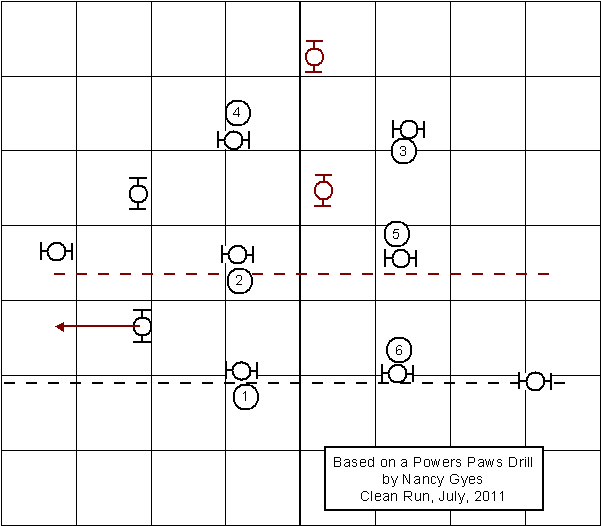
I added the two red hoops to make the exercise easier from behind the bonus lines. I hope to eventually be able to remove the two hoops, but as you can see in the video, they are quite useful for improving the handler's timing and it makes the course more straightforward for the dog. Belle was drawn to the hoop on the left with the red arrow, and I eventually moved it out a good 20 feet so that it was no longer in the picture.
This brings to mind a couple of guidelines for distance training:
- Don't mark mistakes. You want your dog to be comfortable working away from you. Corrections will erode that comfort.
- If an exercise is not going as you hoped, simplify the exercise so that you and your dog can be successful.
After running the course, I decided to alter it so that I could concentrate increasing Belle's send speed. Here is the course as I will be using it tomorrow, along with a couple of suggested sequences:

Saturday, April 9, 2011
Power Paws - Long Way, Short Way: Exercise Three
Here is exercise three from the 03/11 article by Nancy Gyes.

There are a myriad of ways to handle 1-6, and I don't know that it makes much difference which way is chosen, as long as the dog doesn't go off-course. I felt the crucial point of this exercise was how you decided to handle the weaves. Front crossing between #6 and the weaves gave me the feeling I was in control of the run. My second choice would be the blind cross I did at the weave exit. However, much to my surprise, Belle's fastest run was her first complete run on the video where I waited to do a rear cross after she took #6 and then had to run like crazy to catch up in the weaves.
I was absolutely taken by surprise when both Belle and Dusty took went from 1 to 3 on their first attempt on this course. I haven't a clue why they did it. Belle only did it once, but Dusty did it several times. He also went off-course from 5 to 3. I suspect that was because two of the fingers on my left hand were pointing at 3 as I went by it.

There are a myriad of ways to handle 1-6, and I don't know that it makes much difference which way is chosen, as long as the dog doesn't go off-course. I felt the crucial point of this exercise was how you decided to handle the weaves. Front crossing between #6 and the weaves gave me the feeling I was in control of the run. My second choice would be the blind cross I did at the weave exit. However, much to my surprise, Belle's fastest run was her first complete run on the video where I waited to do a rear cross after she took #6 and then had to run like crazy to catch up in the weaves.
I was absolutely taken by surprise when both Belle and Dusty took went from 1 to 3 on their first attempt on this course. I haven't a clue why they did it. Belle only did it once, but Dusty did it several times. He also went off-course from 5 to 3. I suspect that was because two of the fingers on my left hand were pointing at 3 as I went by it.
Friday, April 8, 2011
Power Paws - Long Way, Short Way: Exercise Two
Today, I ran Exercise Two with Belle and Dusty.

Since 2 to 3 is a 270, my preference was to stay in the box and try to produce as tight a line as possible by pulling my dog from 2 to 3. After sending the dog over 4, I did a rear cross. I finally tried a front cross between 3 and 4 with Dusty, and it worked quite well once I got my timing right.
I normally opt for the simplest handling solution, so I would probably never think to do a front cross here which is unfortunate. When I went out a second time to work on this exercise, I realized I had to wait for Belle to pass me by in order to do a rear cross. Rule of Thumb: If you have to wait in order to do a rear cross, perhaps you should be doing a front cross.
I used four different handling combinations at 6 and 7:
1. FX between 6 & 7 and a second FX to wrap the dog back into the gap. This worked with Belle, but with Dusty it was not a very good choice.
2. Send over 6 and move backward to threadle the dog over 7, and then move back again to threadle the dog to the tunnel. (I.e., I had Belle and Dusty run across my feet to the tunnel.)
3. FX between 6 & 7, and then RX 7, wrapping the dog left to the tunnel. I felt this was a faster option than number 2 above. The only problem was that I felt like was signaling the RX from a very strange position.
4. Send over 6 and move backward to threadle the dog over 7 and execute a post turn to wrap him left to the tunnel. Once I figured out how I had to move, this became my favorite way to handle 6-8. I also think it was the fastest.
The threadle/post handling described in #4 above are in this video:

Since 2 to 3 is a 270, my preference was to stay in the box and try to produce as tight a line as possible by pulling my dog from 2 to 3. After sending the dog over 4, I did a rear cross. I finally tried a front cross between 3 and 4 with Dusty, and it worked quite well once I got my timing right.
I normally opt for the simplest handling solution, so I would probably never think to do a front cross here which is unfortunate. When I went out a second time to work on this exercise, I realized I had to wait for Belle to pass me by in order to do a rear cross. Rule of Thumb: If you have to wait in order to do a rear cross, perhaps you should be doing a front cross.
I used four different handling combinations at 6 and 7:
1. FX between 6 & 7 and a second FX to wrap the dog back into the gap. This worked with Belle, but with Dusty it was not a very good choice.
2. Send over 6 and move backward to threadle the dog over 7, and then move back again to threadle the dog to the tunnel. (I.e., I had Belle and Dusty run across my feet to the tunnel.)
3. FX between 6 & 7, and then RX 7, wrapping the dog left to the tunnel. I felt this was a faster option than number 2 above. The only problem was that I felt like was signaling the RX from a very strange position.
4. Send over 6 and move backward to threadle the dog over 7 and execute a post turn to wrap him left to the tunnel. Once I figured out how I had to move, this became my favorite way to handle 6-8. I also think it was the fastest.
The threadle/post handling described in #4 above are in this video:
Thursday, April 7, 2011
Power Paws - Long Way, Short Way: Exercise One
I set up the Power Paws drill created by Nancy Gyes for the March, 2011, issue of Clean Run. I had a lot of fun with the first exercise. The primary considerations were which way to wrap your dog around #4 and are you going to try handling 4-7 with the dog on your right or your left or a combination of the two?

I had quite a bit of trouble getting Dusty to take #7 from the correct direction. Given his speed and his ability to turn off an obstacle in the blink of an eye, I think the best choice was handling him off my right in the weaves and allowing him to go ahead of me over #6 so that I could do a rear cross.
With Belle, almost every combination worked, but the fastest time was produced by wrapping her left around #4 while I stood about half way between #3 and #5. This allowed me to sprint along the outside for the closing. However, I did have to make sure that I held my ground long enough for Belle to make the weave entry.
I also found that as Belle got faster, it became harder and harder us to get the last two jumps if I was handling from the outside. I just couldn't get there fast enough unless I started running before Belle entered the weaves, and she just isn't quite ready for that. Therefore, the best way for me to handle this was to do a front cross at the weave exit. It resulted in a slightly slower run, but at least it allowed me to cue Belle as to the last two jumps.

I had quite a bit of trouble getting Dusty to take #7 from the correct direction. Given his speed and his ability to turn off an obstacle in the blink of an eye, I think the best choice was handling him off my right in the weaves and allowing him to go ahead of me over #6 so that I could do a rear cross.
With Belle, almost every combination worked, but the fastest time was produced by wrapping her left around #4 while I stood about half way between #3 and #5. This allowed me to sprint along the outside for the closing. However, I did have to make sure that I held my ground long enough for Belle to make the weave entry.
I also found that as Belle got faster, it became harder and harder us to get the last two jumps if I was handling from the outside. I just couldn't get there fast enough unless I started running before Belle entered the weaves, and she just isn't quite ready for that. Therefore, the best way for me to handle this was to do a front cross at the weave exit. It resulted in a slightly slower run, but at least it allowed me to cue Belle as to the last two jumps.
Subscribe to:
Posts (Atom)