Showing posts with label training sequences. Show all posts

Sunday, November 3, 2013

The Willies - A Backyard Exercise

Willie's understanding of my handling has grown by leaps and bounds.  Last week, I designed a setup that would allow us to work on several different skills.


Getting the white circle ending proved very difficult for us.

Here is the video of Willie and me working on one of the sequences.  The emphasis was supposed to be on the rear cross to the tunnel, but much to my surprise it became an exercise in getting the third jump in a pinwheel.

Tuesday, September 3, 2013

A Little Bit of Motion Gives Clear Direction

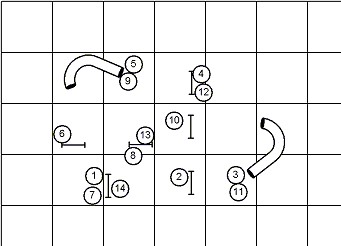
I set up the course below  based on the Balsell's course I posted a few days ago. 


This is just one of several sequences we ran.  Last night, I decided to add the dog walk at the periphery of the course so Belle and I could get in some DW practice.  This morning I added the two hoops and moved jump 5 to the square #13 position to produce this challenging course.  At least it proved to be challenging for Belle and me.
Our first problem was getting from tunnel 4 to tunnel 5.  My path is along the orange line and my plan was to get to the left wing of 6 and send Belle to tunnel 4.  Wrong.  When I stood still and tried sending her to 5, she came over 6.  When she realized that wasn't what I wanted, she defaulted to turning right out of 4 and taking 9.  (Over the last few days, more times than not, that is the direction I asked her to take in the sequences we worked on since it gave us so much trouble in the original course.)

I finally wised up and realized I had to keep moving along the orange line until Belle had passed the middle of jump 6.  Standing still just wasn't going to cut it with this dog and in this particular sequence.  It doesn't matter where I am along that line since it is not my proximity to the tunnel that matters.  What cues Belle to take the tunnel without taking the off-course jump is my movement along the that line until she is committed to the obstacle.

Next bobble was the backside jump, #11.  Belle is used to working with lateral distance and although I didn't have my left arm extended out to the side, it was far enough away from my body that Belle took the dog walk.  The solution here was simple.  Keep my arm even lower, call Belle's name and make eye contact with her.

The last two challenges involved which way to wrap after the straight tunnel.  Once again, since we've been working on wrapping away after a tunnel, Belle's preference was to turn right.  Getting her to turn left proved to be quite a bit harder.  I finally realized that what I had to do was make sure that my motion was going in the direction of the turn I wanted before Belle entered the tunnel.  As soon as she was committed to the tunnel, I could make the left turn indicated on the purple line if I wanted a left wrap.  If I wanted her to wrap right, I had to keep moving along the green line until she was in the tunnel.

Sunday, August 14, 2011

Preparing for Champs

NADAC Championships are only two months away, and I decided it was time to start memorizing and running some longer courses.  I found a suitable candidate in my files.  The original course is the one numbered on the course map below--there's even a distance line.  All of the unnumbered jumps were added by me.

My focus this week is going to be on memorizing 30-35 obstacles and hopefully being able to run them.  From watching video of last year's Champs, it seems that the course occupies significantly more area than this one.  However, in the interests of building up my endurance gradually, I decided to keep the spacing of this course like it would be at a regular trial.

Friday, I ran both Dusty and Belle on the course above, and both of them had off-courses--Dusty went from #16 to the wrong end of the #17 tunnel; Belle took the #16 jump instead of the dogwalk upon exiting the #18 tunnel.  I noticed that Belle was coming out of the tunnels at a reduced speed and checking in for directions.  So I removed the bars on jumps 3 and 4/16, and had Belle and Dusty run fast little sequences using those two jumps and the three tunnels.  That's a little game we will be playing for the next five or six days.
__________________________________________

Today, Sunday, I decided to video our runs.  Much to my surprise, Dusty ran the regular course perfectly.  Next, Belle and I tried the 29-obstacle course I designed:


After a few false starts, I re-thought my handling plan and we were able to get through the entire course.  I was thrilled to discover that I could memorize a 29-obstacle course and that I had the stamina to run it.  

Due to my tweaking, this course calls for a lot of  handling of almost all of the sequences involving one or more of the tunnels.  I guess I have to go back to the drawing board and come up with a course that flows better and that will give me opportunities to work lateral distance in preparation for Champs.

Wednesday, June 29, 2011

Left, Right or Straight Ahead--A Distance Exercise

This morning, I created a short sequence on the jumpers course I set up last week that allowed me to test my ability to direct Belle and Dusty's to one of three jumps upon exiting a tunnel.

Here's the course map.  I have three different ways to start the sequence.  You could also start by sending your dog through the gap between 1a and 1c directly to the #2 jump.


With Belle I was able to get the job done from the farther line.  With Dusty, I had to get close to the line nearer the tunnel exit.  But what I found really interesting was the difference in the default jump between Belle and Dusty.  Belle's natural choice was 5c; Dusty's was 5a.  I was rather at a loss for how to direct Belle's attention to 5a.  What finally worked was calling her name as she exited the tunnel.  By getting her to look toward me, I took her focus off of 5c and was able to redirect her to the correct jump.

Getting Dusty out to 5c was much harder to accomplish.  I had to step in dramatically and resort to an off-arm along with a strong "Out."

Jump 5b was not a tempting off-course choice for either dog, but when it was the correct choice, a simple "Come" was enough to direct both dogs to it.

Wednesday, June 15, 2011

Ad Libbing


I had my DH set this practice course up last week.
The layout provides a lot of opportunities to work on a little doggy NASCAR, tight turns and wraps, and turning at a distance.  Yesterday I finally had enough energy to get the tripod out and film my practice with Belle.  I also brought out Dusty for the first time in seven weeks.  Normally, Dusty is like a red tornado on the course.  But he seemed to be really inhibited by my lack of motion.  Unfortunately, I forgot to start the camera rolling again for his workout.

Here's the video of Belle from yesterday:

Saturday, March 19, 2011

Turns and Wraps

I set up a small course this morning to demonstrate how to work on getting your dog to distinguish between going forward, turning and wrapping.  I used Libby as my demo dog.  Since Libby is less than obsessed with agility, I have to put a lot of myself into a run in order to keep her on track.  I also keep any training I do with her short, quick and fun.  If she makes a mistake (or more likely I make a mistake), I try to ignore it.

Monday, February 28, 2011

A Little Practice for Our Upcoming USDAA Trial

Belle and I are entered in a USDAA trial next weekend, so I've been studying USDAA video and course maps for the last few days in order to prepare for the course challenges we will be facing.

While analyzing runs, I came to the realization that moving my foot to indicate a change of direction just before Belle enters a tunnel or takes a jump gives her a lot more information than just using my arms and upper body.  I also came to the realization that often when I send Belle into a tunnel, by the time I am decelerating and indicating a change of direction she is already in the tunnel and unable to see me.

Here's our video footage from today's practice:

Wednesday, February 23, 2011

Straight Lines

Two or three years ago, I attended a evening seminar given by Dana Pike.  The most valuable lesson I came away with was how to train my dog to run a straight line.  Here is the exercise Dana showed us:

Set up a tunnel and the first three jumps as shown on the left.  (The jumps are spaced 15-20 feet apart.)  Send your dog into the curved tunnel and start running as indicated by the line.  His job is to take the two jumps in his path and catch up with you.  Don't forget to reward him handsomely for a job well done.  Once your dog understands the game, add two or three more jumps one at a time, and repeat the exercise.

Now we're going to make the exercise a little more difficult.  Slide the second and fourth jumps about six inches out of line with the other three jumps as shown in the second figure.  Run the exercise.  If your dog still understands his job, wonderful.  If he doesn't, try off-setting jumps two and four by only three inches.  Once your dog is taking the jumps and catching up to you, you will want to send him to the tunnel from further back as indicated in the middle figure so you can beat him to at least the fourth jump.

When you run be sure not to look back at your dog.  If necessary, have someone watch while you train so you know your dog is taking the jumps.  Your job is to pick your arms up and run to the finish line.  Looking back at your dog delivers mixed signals to him.  According to Stuart Mah, looking at your dog is a signal for handler focus and collection; looking at the obstacles is a signal for your dog to be in obstacle focus and extension.  This is most definitely a training exercise in obstacle focus.

Once you dog is comfortable with the jumps being off-set at six inches, start angling the jumps.  Then gradually introduce more off-set and a greater amount of angling.

Once you dog understands the exercise, you can try handling it from the other side of the red line I have included in the course at the far right.  If you run along the red line, I can just about guarantee you that your dog will not make it down the line of jumps.  Remember:  The Line is not your friend.  It isn't there to show you where to run; it's there to show you where you may not go.

If you are using wingless jumps, make sure there is an inch of two of overlap from one jump to the next.  If you are using jumps with wings, I'd work toward having my dog understand the exercise with the wing of the proceeding jump in line with the wing of the next jump.  Be sure the jumps are spaced far enough apart that your dog can run a fairly straight line when they are off-set from each other.

I have found this to be an invaluable skill with Belle.  I can turn my back on her and run as fast as I am able and be confident that she will take the obstacles in her path when they are arranged more or less in a straight line.  In addition to using this skill to drive for the finish line whenever possible, sometimes I can use it to allow me to get to places I might not otherwise be able to get to in order to handle more complicated sequences.

Tuesday, February 22, 2011

Turning vs. Straight Ahead

I originally wrote this article in 2005, and I am choosing to leave it written in the present tense.  I deleted much of the description of my handling of the different sequences and made a few minor editing changes from the original. RK

My second agility dog is a small (18.5 inch) Australian Shepherd who made her trial debut in October, 2004.  I quickly discovered that a straight line of obstacles builds enough speed in my young girl that is difficult to get her to turn if there is an off-course obstacle that will allow her to continue on that straight line.

My agility area is somewhat limited (60 x 70) and it is impossible to set up a complete NADAC course with enough distance between obstacles to encourage Libby to develop the speed she runs with in a trial setting.  I came up with the course below which employs only six jumps and two tunnels and utilizes as little as 30 x 50 feet.

My goals were:

  1. Teach Libby the obvious obstacle is not the next obstacle when Mom is indicating a change of direction.
  1. Make a course that could be simplified enough and interesting enough that we could do a little doggy NASCAR to build speed which would enable us to work on communication at trial speeds.
  1. To sharpen my ability to communicate change of direction so that Libby would have sufficient information in time to take the next obstacle in a sequence.  This course turned out to be really good for this because I could position myself  as Libby went into a tunnel and concentrate on where she ended up when she failed to pick up my signal.  (See Course 4.)
  1. To increase the distance from which Libby can read my signals – This entails both improving my timing and her awareness of increasingly subtle signals.
I first pattern trained Libby to run the outside loop in both directions at top speed as shown at the side.  This helped us work on increasing speed and having a good time.  To us humans, this looks like a circle, for the dog it is basically a straight line since the curves come in at the tunnels and there are no changes of direction.  To keep this a game, I would call Libby randomly to play tug or chase her favorite toy, a soccer ball.

Then I introduced the pinwheel and serpentine options:

I used a curved tunnel to build speed before hitting the pinwheel.  If your partner is new to pinwheels and has tendency to build up to warp drive, you could start at 4 or 5 instead and move back your start back to 3, then 2, then 1, as your dog gets the idea of a pinwheel.

In working this pattern, I had to go into the pocket of the pinwheel at first, but my aim was to be able to stay on the tunnel side of the first and third jumps of the pinwheel for both the pinwheel and the 11 thru 13 progression.

After doing the pinwheel in both directions, there are a multitude of options, two of which are shown.  After taking tunnel 11, either of the jumps labeled 12 could be selected to vary the course. 


Try working the serpentine from both sides.  Strive to get from the serpentine to #12 as efficiently and quickly as you can.

Here is another variation that allows you to test your team's skills on a fast serpentine.


Here are a few more sequences that I used with this set-up. 


In this sequence, the dog/handler team has the opportunity to run a three-jump slice sequence and a tunnel-jump-tunnel slice, as well as the pinwheel.


How many ways can you think of to handle the change of sides called for between 7 thru 9?  You can spice this one up by picking a different jump 13 each time you run.


In this exercise, we use the pinwheel at 8, 9, 10.  Coming out of tunnel 11, there is an option of the three-jump slice (12 thru 14) or a quick run thru another tunnel (the black 13).


A 13-obstacle that offers the chance to build some speed before doing a serpentine followed by a pinwheel and a 180.  As your team’s speed increases on this course, you’ll know that your dog truly understands that the next obstacle is not always the obvious one.


Here are two final variations for you to play with.


Sunday, January 9, 2011

Practice Course - Turning off a Straight Line

After the New Year's trial, I set up the course on the left to work on 1) sending Belle to a tunnel and 2) having her turn off a straight line to the tunnel to a jump.  Once it gets above freezing, I will bring out a short tunnel and set up the course more like this.


There are any number of sequences that can be run on this course.  Here are four to start you off.  Have fun, and if do set up this course, I'd love to see video of you and your dog running it.

Monday, January 3, 2011

New Year's Day Chances Strategy - Lead Out Required

The QCDC New Year's Day Chances course was a very difficult (if not nearly impossible) course to run successfully at any level if you were unable to lead out.  I believe there were three elite Q's, two open, and one novice.  There were two possible lead out options, but if you and your dog couldn't do one or the other, it was game over.  
 
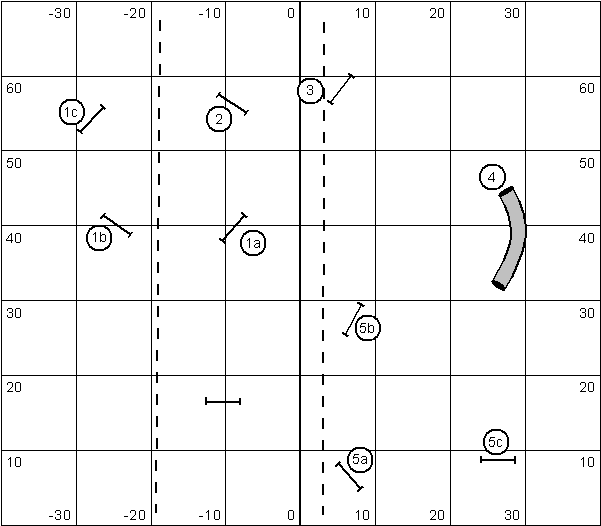
With no lead out, the handler is forced to run toward the off-course jump along the path indicated by the dashed red line.  Two or three dogs were able to get to #4 with a verbal "get out" as their handler ran along this path.  HOWEVER, those dogs all went into the tunnel under the A-frame.
I have trained a little bit with Dana Pike and have been strongly influenced by Linda Mecklenberg's writings in Clean Run and by Jane Simmons-Moake writings on unleashing the velcro dog.  I don't want my dog to ignore my body language.  It's one thing to slide laterally while facing your dog and keeping pressure on his line.  It's quite another to have him do one thing while you do another simply on a verbal.  I think the dogs who took #4 only because of a verbal demonstrate the downside of diluting the importance of your body cues.

Of course, the problem is there are a lot of fast dogs who don't have a start line stay.  However, with a solid start line stay, there are two options.


First, you can just lead out to anywhere along or behind the red line.  Release your dog and support his line to #4.  Notice that the handler has enough room to move toward the dog's line if necessary.  This is how I chose to run this course.


The second option is to take enough of a lateral lead out to allow you to be angling toward #4 as you run.  I liked this idea a lot, and there were a few teams that used it.  I chickened out because I felt this option was a little riskier in that there was always a possibility of Belle misunderstanding what I wanted and going from opening hoop to the #11 jump.

A Lead Out Gone Wrong

I'm always happy when I have someone to video my trial runs since I don't have access to formal training anymore.  Making mistakes is a part of the learning process; but it's impossible to learn from your mistakes unless you have a good instructor or observer who can tell you what went wrong AND how to put it right.

I try to be my own observer/instructor, and I depend on video to help me out.  Sunday's tunneler run was such an unexpected fiasco.  Belle has proven herself to be capable of performing some pretty tricky sequences even when I had to take a fairly substantial lead out for one reason or another.  I watched the opening of Sunday's tunneler's run several times to find out why it went to badly wrong and what I could have done differently while still taking the long lead out that I wanted.  Here's what I discovered:

  • The lead out probably would have been more likely to have been successful if I had placed Belle closer to the first tunnel. (I purposely left her further back so that she would build up speed before crossing the start line.) 
  • I failed to notice where Belle was looking when I released her--she was looking a me, not at the entrance of the first tunnel.
  • I ran away from Belle at the start line giving a fairly wide berth to the first two tunnels.  This gave Belle really bad information about the path I wanted her to take when released.  I should have run closer to the right side of the first two tunnels and crossed Belle's intended path in the gap between the second and third tunnels.  This would have given Belle a head's up about where she was supposed to go when released. 
  • When we play snooker, my release word is "come." (I also whisper to her that we're going to play snooker while we're waiting for our turn.)  After leading out, I stand with my hands down and in front of my body inviting Belle to come to me.  I'm also careful to set her up so that she has a direct line to me.  Sometimes there is a red jump along that line; sometimes there isn't.  But the idea I've tried to convey to her is that she is to come to me on the straightest line possible, which is what Belle did on this tunnelers run.  Even though I did none of these things, running away from her on the path that I took was enough to convince her that snooker was the name of the game.  (This I feel is a training issue, but hey, I'm also the trainer.)
  • In this run, I released her with "okay."  "Tunnel" might have been a better choice.  But given all the strong body signals I gave Belle and the training we've done for Snooker, I don't think that would have saved the day. 
  • Lastly, from the standpoint of trying to be a good handler/trainer, I could really kick myself that I didn't just go with the flow and direct Belle into the third tunnel instead of running back to the first tunnel and trying to salvage the course.  In the split second I had to change my plan, I decided this was Belle's mistake and not mine, so I tried to start over.  After watching the tape, I can see that about 10% of the failure in communication was Belle's and a whopping 90% was mine.
Don't get me wrong.  I'm not beating myself up over my mistakes.  I am thrilled to have this opportunity to analyze what went wrong and how I could have handled it differently.  And I look forward to being able to set up sequences where we can work on honing our "extreme" lead out skills.

Monday, November 8, 2010

Strategy: The Lead Out - Part Two

I feel that Belle runs her fastest when I only take a short lead out or a lateral lead out.  However, we also compete in USDAA and AKC, and sometimes the end of a course can be particularly complex.  If it will save me enough energy that I will be able to do a better job with the complex finish, I will take a longer than needed lead out.  Perhaps Belle won't run the course as fast as she might if I took a shorter lead out, but at least I will still be able to breathe at the end when I'm going to really need it.

===============================================

Sometimes a lead out be the easiest way to avoid a tricky off-course trap.  This is the opening from a Grand Prix course we ran last year.  I lead out making sure Belle and I could see each other.  I called and as she committed to #2, I began rotating so I could move toward the tunnel opening.

Many of the handlers who tried to run with their dog on their left ended up sending them to the wrong end of the tunnel, especially if they tried to get in a front cross between #3 and #4.  Those who trusted their dog and did a post turn fared better since they weren't driving to get into position for the front cross.

===============================================

This weekend, I experimented with doing a moving lead out.  I leave Belle at the start line and jog away, releasing her as get far enough ahead.  If you watched the video from Sunday, I am releasing her with a verbal "Okay" while I'm moving.  She seems to find it pretty motivating.

Monday, October 11, 2010

Tunnel Sends, Discriminations and Wraps

I designed the course below so I could work on turning Belle off a straight line to a tunnel and to work on sending Dusty into a tunnel without  head checking.
It can be used for speed laps as shown, with or without the bonus lines; for tunnel end discriminations (white #9 to black #1 or white #1); for tunnel/jump discriminations; and for wrap or tight work. 


Monday, October 4, 2010

More Distance Exercises

I set up another Jane Simmons-Moake course this morning and had a go with Belle and Dusty.  This is the exercise we worked on:

I started with Belle and quickly discovered that getting the correct end of the tunnel (white circle #4) was a very difficult thing.  The first time, Belle took the dogwalk, and on our other attempts, she took the wrong end of the tunnel (white square #4).  I brought out Dusty and figured we'd just mess around and do what we could do with this exercise.  To my amazement, he had absolutely no trouble getting the correct entrance. 

I decided to try this exercise with Belle again and tape it.  Maybe I could see what was going wrong.  I never did figure why it didn't work, but more importantly, we eventually got it right.  Here's the video:

 
My statement above brings to mind advice from Fred Brattain (The Art of Getting Out of Your Own Way).  When you analyze a run, don't think about what you did wrong; visualize what you should have done.  It is a subtle distinction; but one that is worth making.

Tuesday, September 28, 2010

Jane Simmons-Moake


Jane Simmons-Moake has been writing articles about distance handling for at least seven years.  Among my old Clean Run articles are many articles from her "Unleashing Velcro" and "Distance Challenge" series.  Recently, I purchased her book, Unleashing the Velcro Dog, and I certainly would recommend it to anyone who is interested in improving their distance skills.

Exercise One
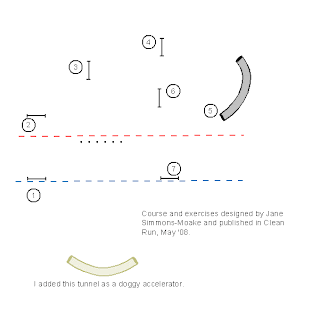
A few evenings ago, I ran across this interesting set of exercises from Ms Simmons-Moake's May, 2008, "Distance Challenge."  I decided to set up the course and see if I might gain some insight on how to get Belle to turn at a distance.  The difficulties we encountered on the first Flying Squirrel Exercise certainly pounded home the fact that I'm pretty much at a loss on how to accomplish this on my own.  I set up this course and worked the first three exercises.
Exercise Two
Exercise Three
Being able to handle the exercises from behind the blue line is the ultimate goal.  However, you and your dog are not comfortable with that much distance, Ms Simmons-Moake recommends using the red line.  As you will see in the video of my efforts, when I need to work on a tough sequence, I move in even closer than that if I have to.

Exercise Four
The only change I've made to the course is the additional tunnel at the bottom of the course map.  It proved to be a great doggy accelerator.

In the video, Belle and I try the first four exercises.  Take note, I actually set the bars in the jumps for a change.


Monday, September 27, 2010

The Flying Squirrel - Exercise 1

I set up the Flying Squirrel and started playing around with it.  I decided the first exercise I'd video would be the simple wrap exercise I shared in Saturday's post. My ultimate goal for Belle is to be able to send her to the tunnel while I remain behind the red distance line.
In the video below, I demonstrate some of the steps involved in increasing the distance from which you can handle the wrap to the tunnel.  I begin with Libby at the "good start" position.  Since she doesn't send to the tunnel the first time, I move in with her as needed.  With a less experienced dog, I would move in even closer to tunnel.  However, since I am working on sending to the tunnel, I would not get closer than  four or five feet to the tunnel entrance.  As the dog gains confidence, I can then work my way back to the black distance line.
When I began writing this post, I thought there were only two components involved in achieving the distance needed to successfully complete this exercise beginning from "the goal" without crossing the purple distance line:  send distance and lateral distance.  As I worked toward "the goal" with Belle, I discovered being able to send her from this spot also involves getting her over jumps A & B and then being able to turn her to the right after C/#1. 
(P.S.  03/21/11.  As you watch the video notice how much more successful we are when I remain in motion rather than coming to a standstill and depending upon arm movement to send the dogs.)

I was pleased with how well the dogs did.  Dusty did a nice job with a bit of increased send distance, and Belle was able to handle both the increased send and lateral distance challenges.  I think that if obstacles #1-#3 had been the only obstacles on the field, Belle and I could have completed this exercise from way out by "the goal."  (I wish I would have thought to try that before tearing down this course.)  When I set up this course again, I will work on the exercise below.  Once we can do that, I'll see if we can get that pesky wrap into the tunnel.


Saturday, September 25, 2010

Meet the Flying Squirrel

I've been working on getting seven years worth of Clean Run articles put into binders so that they are more accessible.  I ran across a figure eight set of exercises that Kathy Keats prepared in "Which Way to Excellence?" (Oct., '04).  I'm always looking for courses that I can set up without having to haul out my surveyor's wheel and tape.  I adapted this basic exercise and came up with the Flying Squirrel.  The possibilities are endless.  (The tail on the flying squirrel is a gate.  If you don't have one, just use another jump.)


In this example, I was working on sending Dusty over the two jumps and wrapping him through the gap to the tunnel without passing the plane of the jumps.  Always work the mirror image of sequences like this since one way proves to be much move of a challenge than the other.  (For Dusty, the sequence on the right was like pulling teeth, and it had to be broken down into even smaller steps.)


Here is a longer sequence using the same set-up.  You can add your own distance line or bonus box if you want to work on distance skills.  


This is the Flying Squirrel on steroids.  By adding the jump below the tunnel, you can work on some pretty tough discriminations at speed.  The gate at the bottom can be replaced with the obstacle of your choice to increase the possibilities even more.

As with most of my training, I don't usually set any bars in the jumps when working sequences using this set-up.  I want my dogs to run fast, and I want to learn to be able to handle them when they're running at their fastest.

Tuesday, September 21, 2010

Live Feed for 2010 NADAC Championships

The Championships begin Thursday, Sept. 23, and run through Sunday.  Tuesday and Wednesday, the live feed will be running with pre-championship courses.


Wednesday, September 15, 2010

Taking Care of Business

I started going through Jane Simmons-Moake’s Clean Run articles a couple of weeks ago looking for ideas I could use in my distance training program.  I ended up ordering her book, Unleashing the Velcro Dog, and found an exercise which involves sending your dog to the end of the dogwalk and wrapping him into a tunnel.  In order to best handle the closing, it is necessary to not pass the tunnel exit.  This means your dog must be able to perform the dogwalk without you holding her paw and you have to be able to turn her into the tunnel without being next to her.  It is painfully obvious that Belle doesn't quite understand where I want her to end up when she does her dogwalk.  In addition to the original purpose of Ms. Simmons-Moake's exercise, I became obsessed with the best way to handle the closing--front cross or rear.  With Belle, the front is best because I have to wait (stand still) in order to do the rear cross.


After running both Dusty and Belle, I decided to add a curved tunnel and an additional jump and devise some other sequences.  In the video below, I’m concentrating on the best way to handle the last three jumps.  I was really intent upon finding out whether a front cross before #7, a front cross between #7 and #8, or a rear cross at #8 was the most effective way to handle the closing.  In this instance, "most effective" means which cross got the fastest closing from my dog.  However, as I found out, you do have to handle all the obstacles if you hope to have a clean run.  (For Dusty, the rear cross was almost as effective as the front cross, and it was a lot easier to do.)


"Women and cats will do as they please and men and dogs should relax and get used to the idea." Robert A. Heinlein