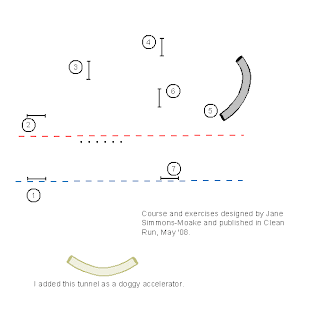
Jane Simmons-Moake has been writing articles about distance handling for at least seven years. Among my old Clean Run articles are many articles from her "Unleashing Velcro" and "Distance Challenge" series. Recently, I purchased her book, Unleashing the Velcro Dog, and I certainly would recommend it to anyone who is interested in improving their distance skills.
Exercise One
A few evenings ago, I ran across this interesting set of exercises from Ms Simmons-Moake's May, 2008, "Distance Challenge." I decided to set up the course and see if I might gain some insight on how to get Belle to turn at a distance. The difficulties we encountered on the first Flying Squirrel Exercise certainly pounded home the fact that I'm pretty much at a loss on how to accomplish this on my own. I set up this course and worked the first three exercises.
Exercise Two
Exercise Three
Being able to handle the exercises from behind the blue line is the ultimate goal. However, you and your dog are not comfortable with that much distance, Ms Simmons-Moake recommends using the red line. As you will see in the video of my efforts, when I need to work on a tough sequence, I move in even closer than that if I have to.
Exercise Four
The only change I've made to the course is the additional tunnel at the bottom of the course map. It proved to be a great doggy accelerator.
In the video, Belle and I try the first four exercises. Take note, I actually set the bars in the jumps for a change.
I was able to get a photo of my cheerful little agility bluebird this afternoon. Looks like he hasn't completely blown his juvenile coat yet. Uh, I mean molted his juvenile plumage.
I set up the Flying Squirrel and started playing around with it. I decided the first exercise I'd video would be the simple wrap exercise I shared in Saturday's post. My ultimate goal for Belle is to be able to send her to the tunnel while I remain behind the red distance line. In the video below, I demonstrate some of the steps involved in increasing the distance from which you can handle the wrap to the tunnel. I begin with Libby at the "good start" position. Since she doesn't send to the tunnel the first time, I move in with her as needed. With a less experienced dog, I would move in even closer to tunnel. However, since I am working on sending to the tunnel, I would not get closer than four or five feet to the tunnel entrance. As the dog gains confidence, I can then work my way back to the black distance line.
When I began writing this post, I thought there were only two components involved in achieving the distance needed to successfully complete this exercise beginning from "the goal" without crossing the purple distance line: send distance and lateral distance. As I worked toward "the goal" with Belle, I discovered being able to send her from this spot also involves getting her over jumps A & B and then being able to turn her to the right after C/#1.
(P.S. 03/21/11. As you watch the video notice how much more successful we are when I remain in motion rather than coming to a standstill and depending upon arm movement to send the dogs.)
I was pleased with how well the dogs did. Dusty did a nice job with a bit of increased send distance, and Belle was able to handle both the increased send and lateral distance challenges. I think that if obstacles #1-#3 had been the only obstacles on the field, Belle and I could have completed this exercise from way out by "the goal." (I wish I would have thought to try that before tearing down this course.) When I set up this course again, I will work on the exercise below. Once we can do that, I'll see if we can get that pesky wrap into the tunnel.
I've been working on getting seven years worth of Clean Run articles put into binders so that they are more accessible. I ran across a figure eight set of exercises that Kathy Keats prepared in "Which Way to Excellence?" (Oct., '04). I'm always looking for courses that I can set up without having to haul out my surveyor's wheel and tape. I adapted this basic exercise and came up with the Flying Squirrel. The possibilities are endless. (The tail on the flying squirrel is a gate. If you don't have one, just use another jump.)
In this example, I was working on sending Dusty over the two jumps and wrapping him through the gap to the tunnel without passing the plane of the jumps. Always work the mirror image of sequences like this since one way proves to be much move of a challenge than the other. (For Dusty, the sequence on the right was like pulling teeth, and it had to be broken down into even smaller steps.)
Here is a longer sequence using the same set-up. You can add your own distance line or bonus box if you want to work on distance skills.
This is the Flying Squirrel on steroids. By adding the jump below the tunnel, you can work on some pretty tough discriminations at speed. The gate at the bottom can be replaced with the obstacle of your choice to increase the possibilities even more.
As with most of my training, I don't usually set any bars in the jumps when working sequences using this set-up. I want my dogs to run fast, and I want to learn to be able to handle them when they're running at their fastest.