I was going to work on the third sequence from Kathy Keats' March series this morning, but since I wanted to rear cross the A-frame, I decided to work on that first. I've never been able to successfully rear cross the A-frame with Belle. I am extremely envious of those who can cut across the heels of their dog and the dog doesn't waiver in its path. When I cross Belle's path, she stalls out at the top of the A-frame.
As I worked through it this morning with Belle, she not only stalled out at the apex, she began stopping at the bottom. You can see me working through these issues in the video. After watching this morning's video, I decided the best way to work on teaching Belle to run the A-frame while I do a rear cross is to start very close to the line I want to cross and work on increasing my lateral distance from that line. Whether or not I want to put the time and effort into teaching it is another matter.
 Ironically, when I was working on getting Belle to run the A-frame without sticking, I discovered that a blind cross between the jump and the A-frame was probably a better choice for the sequence I was planning to run. It has the advantage of keeping me in motion and ahead of Belle. However, I still think that being able to rear cross the contacts is something that has its place in the handler's bag of tricks, and it is a skill I would definitely want to make sure my next dog and I have. On the other hand, this is a skill that Belle and I have managed to do without for five years, so obviously there are ways to run successfully without it.
Last week I devoted my time and energy to painting the dining room and doing spring clean up in my flower beds. The dining room is finished, but the work continues in the garden. However, I finally had a chance to set up a new course to work on.
I chose the March, 2012 set of exercises that Kathy Keats designed for Clean Run since it presents different options before and after the A-frame. Exercise One calls for several wraps, but the one right before the A-frame presented a special challenge for Belle and me since I want her to do a running A-frame. I'm not fast enough to stay at next to the jump for the wrap and handle the turn into the tunnel under the A-frame, so I decided we would work on getting the wrap with a minimal amount of handler help. I thought Belle did a nice job on the A-frame into the tunnel.
 "Tunnel vision" as defined in the online World English Dictionary:
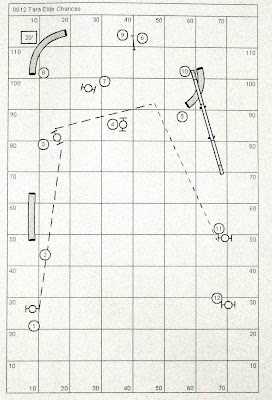
 Although the Q rate in Elite and Open on this Chances course was close to 50%, Belle and I were not among those teams who Q'ed because we feel victim to tunnel vision. There are two meanings of the term "tunnel vision," and our run fell victim to both.
The tunnel in the upper left corner is about 35' away from the exit of the first tunnel, and it never occurred to me that it was a viable off-course. I was focused on the turn to the #3 hoop, and I really thought was it was a given since I practically lead out to it. I felt really bad for blaming Belle for failing to see the obvious, when it was I who had failed to see. Thanks to Cynthia Ernat for pointing out to me how well the corner tunnel lined up with the start line.
 Normally, I would have called Belle as she exited the tunnel. (I know, I know, I should actually call her when she's in the tunnel, but my reflexes suck.) However, in light of how many verbal mistakes I made yesterday, I had resolved to use as few verbals as possible today. This, unfortunately, was a spot that screamed for a verbal cue.
As the dog sits at the start line waiting to be released, if he is looking straight ahead, he sees is the tunnel in the corner looming large and invitingly--especially since today, Chances followed Tunnelers. Even for those dogs with no start line stay, the vision from within the first tunnel was most certainly "tunnel vision."
The other two "traps" on this course were obvious: the dog has to turn from jump #6 to hoop #7, and then there is a dog walk/tunnel discrimination. Unlike the problems we all encountered yesterday getting our dogs to carry out to a hoop after the tunnel, most of the dogs came out of the tunnel and took the jump. Unfortunately, a fair number of them continued on to the off-course tunnel. (This turn away from the tunnel was also tested on both Regular courses, so you had a chance to redeem yourself.)
When we were walking the course, I happened to overhear Cynthia Ernat discussing handling the line from #5 to #6: Instead of turning the dog immediately as he exits the tunnel, it would be better to let him run out ten feet or more before turning indicating the turn. Turning sharply to #6 puts the dog on a path to the off-course tunnel. Allowing your dog to run out from the tunnel first, results in him heading more toward the #7 hoop as he takes the jump.
Chance Statistics
Elite 7 Q's/18 runs
Open 4 Q's/9 runs
Novice 1 Q/13 runs
 We ran this Chances course on Saturday at the QCDC trial.
When I walked this course, I thought the hardest thing for Belle and me would be to turn from the #5 hoop to the #6 jump. I felt she would build up so much momentum that the A-frame would be a very viable off-course. The only other difficulty I foresaw was driving forward from the A-frame to hoop #10 for those dogs who had a stopped contact.
 Oh, well, guess I won't be accepting a job as a course analyst any time soon. The #1 challenge proved to be getting your dog to the #5 hoop. By and large, at all levels, the dog came out of the tunnel looking for his handler and never made it to #5.
 For those dogs that made it to #5 (whether on the first effort or the second), the next problem became turning from #7 to #8. For the unwary handler, which was many of us, our handling path took our partner directly to the off-course tunnel.
Q Statistics
Elite 1 Q/17runs
Open 1 Q/12 runs
Novice 0 Q/15
 Ironically, when I was working on getting Belle to run the A-frame without sticking, I discovered that a blind cross between the jump and the A-frame was probably a better choice for the sequence I was planning to run. It has the advantage of keeping me in motion and ahead of Belle. However, I still think that being able to rear cross the contacts is something that has its place in the handler's bag of tricks, and it is a skill I would definitely want to make sure my next dog and I have. On the other hand, this is a skill that Belle and I have managed to do without for five years, so obviously there are ways to run successfully without it.


