I debated about whether or not to enter Willie in a CPE trial on August 2nd. He was 15 months old on the 22nd of July. I finally opted to run him in Colors, Wild Card and Jumpers since the only obstacle not fully trained (or so I thought) is the AF.
I was hoping to take the DW on the Colors and Wild Card courses, but my knee was bothering me too much to run the length of the DW and when I tried pushing Willie out to them, he took the straight tunnel that was about 10' closer to me and parallel to the DW. A new obstacle discrimination variation for us to work on at home.
Willie's jumpers run was beautiful until the last obstacle which was a tire. Someone thought he had hit the metal support frame with his shoulder, but in slow-motion, it looks like he missed it. Thank goodness for breakaway tires!!!
I thought about the tire incident during the long drive home, mentally kicking myself for almost injuring Willie. When I went to bed last night, I was still considering the matter and came up with a way to "fix" our tire problem. All of my other dogs, except Dusty, were taught to jump through a hula hoop long before they encountered their first tire. From there I went on and worked on transferring that performance to jumping through my arms. Max, my late Airedale, actually won the best trick award in a local competition by impressing the judge with his ability to jump through my arms.
So this morning, I dug out my 24" hula hoop and began the process of teaching Willie to jump through the hoop cleanly. Basically, I will be following these steps:
Begin with the hoop vertical and resting on the ground.
1. Reward any interaction with the hoop.
2. Reward a few passes through the hoop no matter how many body parts touch it. Mustn't stay at this stage very long.
3. Only reward those passes where no part of his body touches the hoop.
Once Willie can get through the hoop without touching it, raise it an inch or so off the ground.
4. Have him sit and wait. Release to come through the hoop for a cookie.
5. Over several sessions, raise the height of the hoop until we get to competition height. Be sure to maintain criterion of no body part touches the hoop.
6. Put the behavior on a verbal cue.
Once Willie can jump the hoop cleanly at competition height, begin working on getting him to jump through my arms. A big plus of jumping through your arms is that the dog will brush against you if he is of any size, and he will learn to do it with control to avoid ramming into you. (Some dogs don't learn this part. I could never trust Dusty to not hit my shoulder, so I stopped offering him the opportunity to do this trick. His tire performance was also less than safe unless it was carefully managed.)
I have found the easiest way to do this is to place one hand on the top of the hoop and the other off to the side toward the bottom, holding the hoop as far from my body as possible. As the dog gets comfortable jumping close to my body, I increase the amount of contact my arms have with the hoop. This will also bring the hoop in closer to my body. Once my arms are wrapped around the hoop to the fullest extent possible, it's time to see if he dog will jump through my arms without the hoop on cue--I keep my fingers about 12" apart for these first attempts. If necessary, I have someone lure my dog through with a cookie. Once he will jump through my arms, I start decreasing the size of my arm "hoop."
Sunday, August 3, 2014


Saturday, June 7, 2014
Distance Handling Check
My original goal with Belle was to get to the point where we were able to do NADAC courses from the bonus line. We almost got there, but not quite. With Willie, I can tell that I'm going to need all the distance I can get in order to get through any course with him since he is considerably faster than Belle. My job will be to navigate and stay out of his way.
I'm having trouble with my right knee, so I decided to find out how well Willie could do this Masters Jumpers course with distance handling. Here's a frame shot from this morning video. Note that I misread the map (again) and we took 10 from the wrong direction.

It was quite the learning experience. I plan to go out and "run" it again tonight or tomorrow morning. I'll finish the video then and post it here and on YouTube.
#1 is a continuing problem with Willie. He doesn't quite get it that if the jump is between him and me and I don't indicate otherwise, he is to take it.
#2 Can you say LATE!
#3 & #4 I missed seeing the threadle at 10, so I cued Willie to jump 10 in the wrong direction and then tried to do a threadle at 11. My initial plan was to handle it from what was our landing side, and getting there pulled Willie off of 9. It also made for a crunchy threadle. It handles much better when I remain on the take off side of 10 and I can also support 9 better. However, now that I see my mistake, I look forward to seeing if we can get 9-11 correct.
#5 I wanted to stay around (52,8), but soon discovered neither Willie nor Belle could get to 15 consistently if I did that. Moving 1/3 to 1/2 way down the tunnel supported that jump just fine. Actually, it's not surprising that Willie didn't carry out to 15 since we've done a lot of work in the last two weeks on tunnel exits. If I'm not moving when he goes in, then he should be checking for me and prepared to turn when he exits.
#6 I had to make sure I supported the double or Willie ran by it. (Perhaps that's because I didn't put a pair of wings on it, but still....) Must remember that Willie is a young, unexperienced dog and what Belle takes for granted, he very well may not.
I'm having trouble with my right knee, so I decided to find out how well Willie could do this Masters Jumpers course with distance handling. Here's a frame shot from this morning video. Note that I misread the map (again) and we took 10 from the wrong direction.
It was quite the learning experience. I plan to go out and "run" it again tonight or tomorrow morning. I'll finish the video then and post it here and on YouTube.
#1 is a continuing problem with Willie. He doesn't quite get it that if the jump is between him and me and I don't indicate otherwise, he is to take it.
#2 Can you say LATE!
#3 & #4 I missed seeing the threadle at 10, so I cued Willie to jump 10 in the wrong direction and then tried to do a threadle at 11. My initial plan was to handle it from what was our landing side, and getting there pulled Willie off of 9. It also made for a crunchy threadle. It handles much better when I remain on the take off side of 10 and I can also support 9 better. However, now that I see my mistake, I look forward to seeing if we can get 9-11 correct.
#5 I wanted to stay around (52,8), but soon discovered neither Willie nor Belle could get to 15 consistently if I did that. Moving 1/3 to 1/2 way down the tunnel supported that jump just fine. Actually, it's not surprising that Willie didn't carry out to 15 since we've done a lot of work in the last two weeks on tunnel exits. If I'm not moving when he goes in, then he should be checking for me and prepared to turn when he exits.
#6 I had to make sure I supported the double or Willie ran by it. (Perhaps that's because I didn't put a pair of wings on it, but still....) Must remember that Willie is a young, unexperienced dog and what Belle takes for granted, he very well may not.
Thursday, December 5, 2013
Teachable Moments
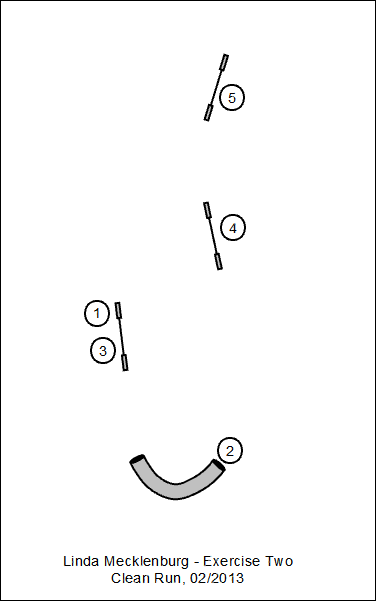
First, there is the backside of #4. We've done a little bit of backside work, but not a whole lot because I don't want him to default to the backside of a jump too easily. The object of this sequence is to handle #4 in at least three different ways. I tried pushing Willie to the back of #4 around the wing closer to the tunnel and then pushing into the gap between 4/5. This proved to be somewhat difficult for Willie because he still doesn't understand collection.
Then I tried pushing him to the backside of #4 around the wing closer to #5. Much to my surprise, this was made getting to #5 easier for him since he was forced to slow down (collect) for the wrap. Unfortunately, I couldn't think of a third way to handle 4/5 yesterday. But I think it might be possible for the handler to get to the take of side of #4 and handle from that side.
Because of his speed and size, Willie defaulted to the correct side of #2. So I was really shocked when this turned into a major sticking point for Belle--she defaulted to my side of the jump. Hmm. I spent several minutes showing Belle the difference in my signals when I wanted her to take the jump going away from me and when I wanted her to take it coming toward me. Then I brought Willie out and worked on showing him what it looked like when I wanted him to take #2 from my side of the jump. There's that hard to grasp concept again, collection. Once he got the idea of coming to my side of the jump, I started asking him to wrap it and go back into the tunnel. Surprise! He took the jump first, which gave us another skill to work on.
We quit for the day at this point, but in addition to wrapping to the tunnel, there are several other choices:
- the other end of the tunnel
- either side of #4
- either side of #5
- the gap between 4/5
Wednesday, December 4, 2013
The Mental Game
Just a few random thoughts for today's Dog Agility Bloggers Event, "The Mental Game."
First and foremost, it is a GAME. Games are supposed to be FUN. Fun for you and fun for your dog. Nothing brings me down so much as watching a handler blame his dog for mistakes on course. The mistakes are almost always the handler's--either she messed up her handling or she hasn't proofed her dog sufficiently, or Dog forbid, she did a crappy job of teaching some aspect(s) of her dog's performance.
In the same vein, don't beat yourself up over handling mistakes. Jot it down and come up with some ideas to work on your skills so that you can handle the sequence, trap, whatever better the next time you see it on a course.
Use the course maps to memorize the sequence of the courses before you walk if at all possible. If you can, watch while the course is being built to mentally test how well you've memorized the course. Then you can spend your walk through time on analyzing what your dog sees and planning your handling. Even after all these years, I'm not terribly good at estimating where my dog and I will be relative to each other, so I usually try to have a Plan B. One thing that I used to overlook frequently was where to set Belle at the start line so she would be able to see me and the obstacles between us. Duh!
Unlike many handlers, I usually don't use all the walk through time allotted. Sometimes, that bites me in the butt, but usually it works for me. Once I've decided on a plan and know where the control points are and how I'm going to get there, I try to get to them once or twice and then I get out of Dodge. If I'm running early in the order, I want to spend the time with my dog. If I'm running later, then I have plenty of runs to watch to see if I missed something.
Plan your run, and run your plan. Well, usually, but sometimes I see another handler do something that is much more logical, efficient, elegant, whatever, than what I had planned. I'm not above giving it a go without having walked it. However, I will rehearse the move mentally. If subsequent handlers do the same move, I have an additional chance to mentally work on my timing.
Above all, have fun and make sure your dog is having fun, too!
First and foremost, it is a GAME. Games are supposed to be FUN. Fun for you and fun for your dog. Nothing brings me down so much as watching a handler blame his dog for mistakes on course. The mistakes are almost always the handler's--either she messed up her handling or she hasn't proofed her dog sufficiently, or Dog forbid, she did a crappy job of teaching some aspect(s) of her dog's performance.
In the same vein, don't beat yourself up over handling mistakes. Jot it down and come up with some ideas to work on your skills so that you can handle the sequence, trap, whatever better the next time you see it on a course.
Use the course maps to memorize the sequence of the courses before you walk if at all possible. If you can, watch while the course is being built to mentally test how well you've memorized the course. Then you can spend your walk through time on analyzing what your dog sees and planning your handling. Even after all these years, I'm not terribly good at estimating where my dog and I will be relative to each other, so I usually try to have a Plan B. One thing that I used to overlook frequently was where to set Belle at the start line so she would be able to see me and the obstacles between us. Duh!
Unlike many handlers, I usually don't use all the walk through time allotted. Sometimes, that bites me in the butt, but usually it works for me. Once I've decided on a plan and know where the control points are and how I'm going to get there, I try to get to them once or twice and then I get out of Dodge. If I'm running early in the order, I want to spend the time with my dog. If I'm running later, then I have plenty of runs to watch to see if I missed something.
Plan your run, and run your plan. Well, usually, but sometimes I see another handler do something that is much more logical, efficient, elegant, whatever, than what I had planned. I'm not above giving it a go without having walked it. However, I will rehearse the move mentally. If subsequent handlers do the same move, I have an additional chance to mentally work on my timing.
Above all, have fun and make sure your dog is having fun, too!
Subscribe to:
Posts (Atom)